

Nature at Work
How to create healthier workspaces that invite creativity and focus

I think we can all agree that there is nothing more uninspiring than the traditional, corporate workplace. The grey walls, the bright lights, the generic furniture. Depressing. But splashing around bright yellows and futuristic armchairs also isn’t the answer. So what makes a space inspiring to work in? And what do we need to consider when refining our own creative spaces?
You would think that, considering how much time we spend in “work mode”, the look and feel of our desks and offices wouldn’t be an afterthought. But most of the time they are. We hunch over our laptops on our beds, we type out long emails on our phones until our fingers seize up, we squeeze our laptop amongst the piles of laundry spread across the desk (just me?) and dutifully water the sad-looking plant in the corner. At the same time, we (and yes-I’m referring to myself here) wonder why we continually feel uninspired and struggle to fall into those deep states of flow that appear every once and again.
The thing that is missing is INTENTION. We are forgetting to be intentional about how we transition into a state of productivity. We are dismissing the importance of rituals and routines that help us enter a state of focus and creativity, not only through our physical surroundings but also our mental, emotional and energetic states. If we are not carefully curating our environment, then we end up absorbing and, in some cases, amplifying whatever residual energies are already occupying the space.
As someone who recently moved into a newly, self-built home and is yet to have even started, let alone finish, the home office (despite having all the best intentions and a very detailed pinterest board of what I want to create for the space) I am curious in workplace design not only because of the field I’m in but also because these are things I’m currently considering in my own home and also in the local coworking space that I manage with my partner.
I want to explore some ways that we can begin the curation process and turn our workspaces into a personal sanctury that invites us to dive in and immerse ourselves in the creative process of our work. This is important for everyone but especially for people who are extra sensitive to the spaces around them (anyone with an open Identity centre in their Human Design chart, especially Projectors and Reflectors).
Step 1: The Workspace Audit
What works, what doesn’t? Identify the parts of your home office or work space that you find triggering or that aren’t currently working how they should. The key to flow and ease in a functional space is always ORGANISATION. If things don’t have a place, it will eventually cause clutter and you will feel more overwhelmed. INVEST in the initial time and money to allocate a space for everything (even down to a basket for the power cords- it makes a difference!)
This part can be difficult in a space that we don’t have true ownership over, such as a shared office or an office within a sterile building with a specific layout and rigid specifications for furniture. This will require some more creativity and open conversations with colleagues and management in order to offer some education around the importance of feeling inspired and comfortable in work settings, as well as the potential health and well being benefits. You might get some wary looks as you traipse past carrying yet another pot plant, but you also could start a movement as more people jump on board and begin curating their spaces.
Step 2: Create a connection with nature
The term biophilic design has been making the rounds lately, and you could easily be forgiven for believing it is cutting edge or novel within the world of architecture and interior design. The term biophilic, however, refers to the human tendency to interact or be closely associated with other forms of life in nature and the desire or tendency to commune with nature. This approach to design is simply a return to our human nature. Our ancestors relied on natural environments for survival, and we have developed instincts and preferences that favor elements conducive to well-being and safety. Today, this innate bond manifests in our psychological, emotional, and physical responses to nature, with recent research showing results such as reduced stress, improved mood, and enhanced cognitive function when humans are exposed to natural elements within their spaces.
Some of these benefits include;
Improved air quality: Live plants help purify the air by absorbing carbon dioxide and producing oxygen. They also increase humidity, which can help combat dry air issues in air-conditioned offices.
Stress reduction: Biophilic environments have been shown to reduce physiological stress and psychological anxiety levels.
Enhanced productivity: Studies from Exeter University found that employees were up to 15% more productive in workspaces with biophilic elements.
Better mental health: Visual connections with nature can positively impact attitude, overall happiness, and lower the incidence of depression.
Improved physical health: Exposure to natural elements can lower blood pressure and heart rate, and is linked to lower incidence of heart disease and diabetes.
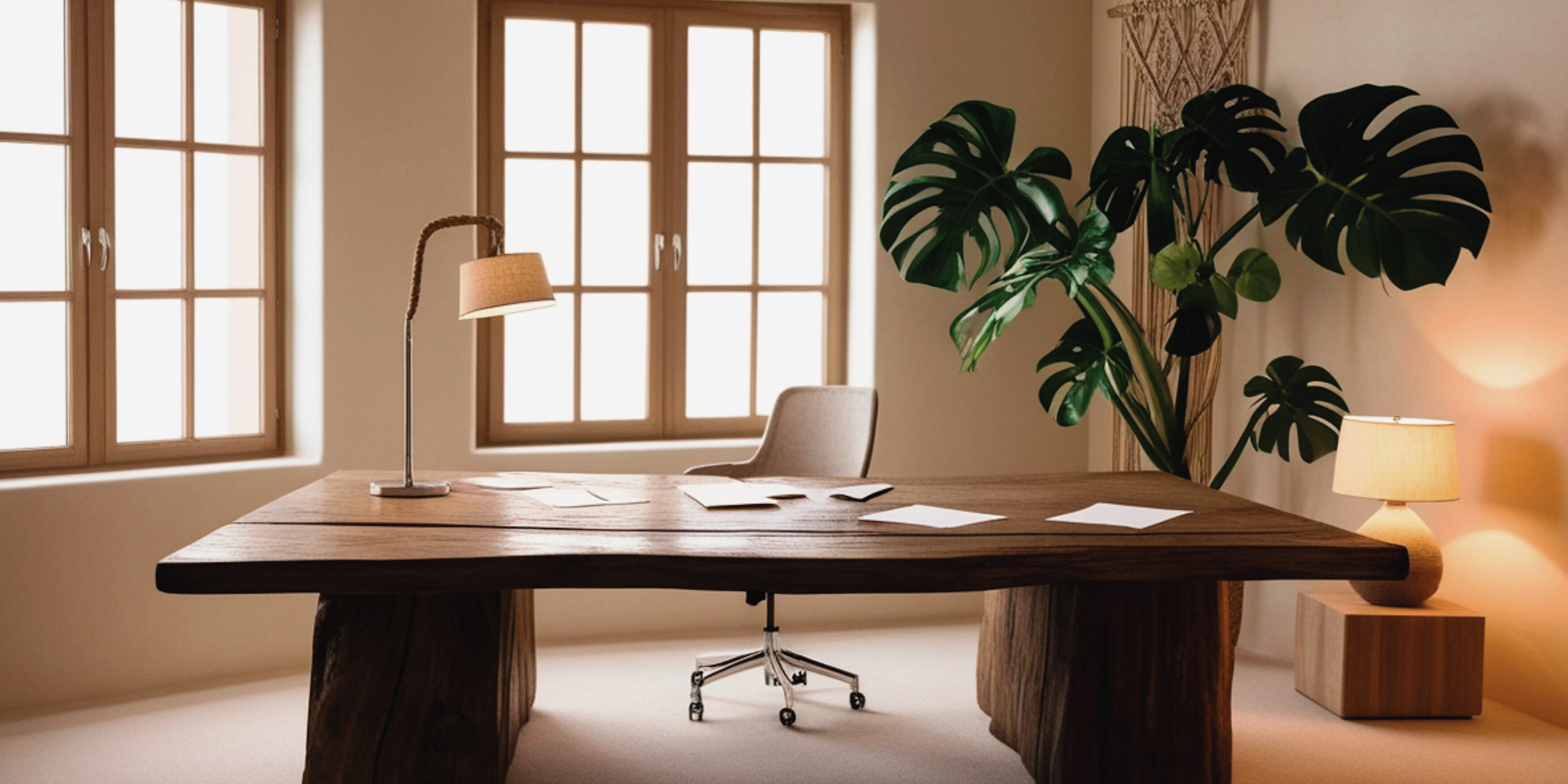
So what are some simple ways to incorporate biophilic design into your work space?
Add in in more greenery (plants, plants and more plants!)
Add potted plants to desks, shelves, and common areas
Create a green wall or living wall if space allows
Use hanging planters or vertical gardens for smaller spaces
Maximise natural light
Position desks and workstations near windows
Remove heavy curtains or blinds that block light
Use mirrors to reflect and amplify available natural light
Use natural materials and textures
Choose furniture made from real wood
Use natural textiles like wool, cotton, or jute for rugs and upholstery
Add natural textures through wall coverings or decorative elements
Use organic shapes and forms, where possible
Try to choose furniture and decor with curved lines and organic shapes as our eye is naturally drawn to natural curves and these can be more calming to be around.
I wrote about the impact of a physical space on our levels of inspiration in this previous post and it mentions how our initial psychical reaction to a space is directly related to how safe our bodies feel.
Step 3: Personalise your work environment
The Environment aspect of the Human Design bodychart can offer insights into the most supportive environments for us. These are the spaces and dynamics that will see us thrive and bring our bodies a sense of vitality. There are six different Environments; three hardscapes (Caves, Markets and Kitchens) and three landscapes (Mountains, Valleys and Shores). How you are designed to interact with your physical environment is also influenced by the direction of the arrows at the top of your chart and you can read more about this in my previous post here.
If you are unsure of your Environment you can look up your bodychart here (*please note, you will need to know your accurate birth time in order to find your correct Environment). As with everything in Human Design, the Environment aspect should be approached as an experiment for you to explore with curiosity and discernment.
Below are some quick and easy ways to experiment with your workspaces, according to your Environment type.
Caves Environment
People with a Caves Environment are seeking safety and security in their environments. They may feel drawn to cosy nooks or offices where they can have their back to the wall and monitor who approaches and enters their space. Often these people are more private about what information they share with colleagues and may find shared office spaces unsettling.
Choose a cosy, enclosed space for your desk, such as a corner or alcove. or with your back to the wall and facing the doorway.
You concentrate better when you have control over who enters, ideally with just one entry point and minimal surprises.
Use heavier curtains, warm lamps, soft blankets, and position yourself with a solid wall behind you.
Markets Environment
People with a Markets Environment enjoy having options and being selective. They like to experience what’s on offer before they make a choice and thrive in environments focused on trade, not just literally trading products or services, but also an exchange of ideas, energy or expression.
Infuse your workspace with variety: display different colors, textures, art pieces, visual pinboards and things that can be changed up regularly
Add a vision board to swap out inspiration and remind you of projects that you’ve worked on or that inspire you in some way.
Bring in different scents, background music or mementos from places you’ve been or places you want to experience to keep the atmosphere stimulating and amplify the sense of options and choice.
Kitchens Environment
People with a Kitchens Environment like to be in the middle of the action and are drawn to places of transformation. This might look like a co-working space or any central hub where people come together to work creatively and share resources- (ingredients) in a process of alchemy.
Choose a collaborative area that is centered amongst the action of whatever space you’re in (the kitchen table at home, a meeting room in the workplace or a coworking space)
Keep your tools (art supplies, books, charts, cameras, products, lighting ) visible and easily accessible for quick experimentation when you feel inspired.
Host brainstorming sessions or innovation hubs between different teams or networking events with peers in your field that encourages new ideas and offer a safe space for growth and transformation.
Mountains Environment
People with a Mountains Environment tend to retreat away from others to gain perspective and clarity. They may feel drawn to elevated spaces or levels that have access to an outdoor view. They are also likely to crave fresh air and open spaces to help them regroup, reconnect with themselves and take things in from a new perspective.
Elevate your workspace: set up on a higher floor or spot with a view, like a window overlooking a street or garden.
Open, airy layouts and decluttered spaces help you maintain perspective and mimic the feeling of stepping back to take in the bigger picture.
Use raised seating and shelves to achieve a sense of being ‘above,’ both literally and energetically.
Valleys Environment
People with a Valleys Environment are seeking intimacy and connection in their surroundings. They value honest conversation and like to be immersed in the social scene of a space. These people are also strongly influenced by the acoustics of their environment and like to be close to the source of information.
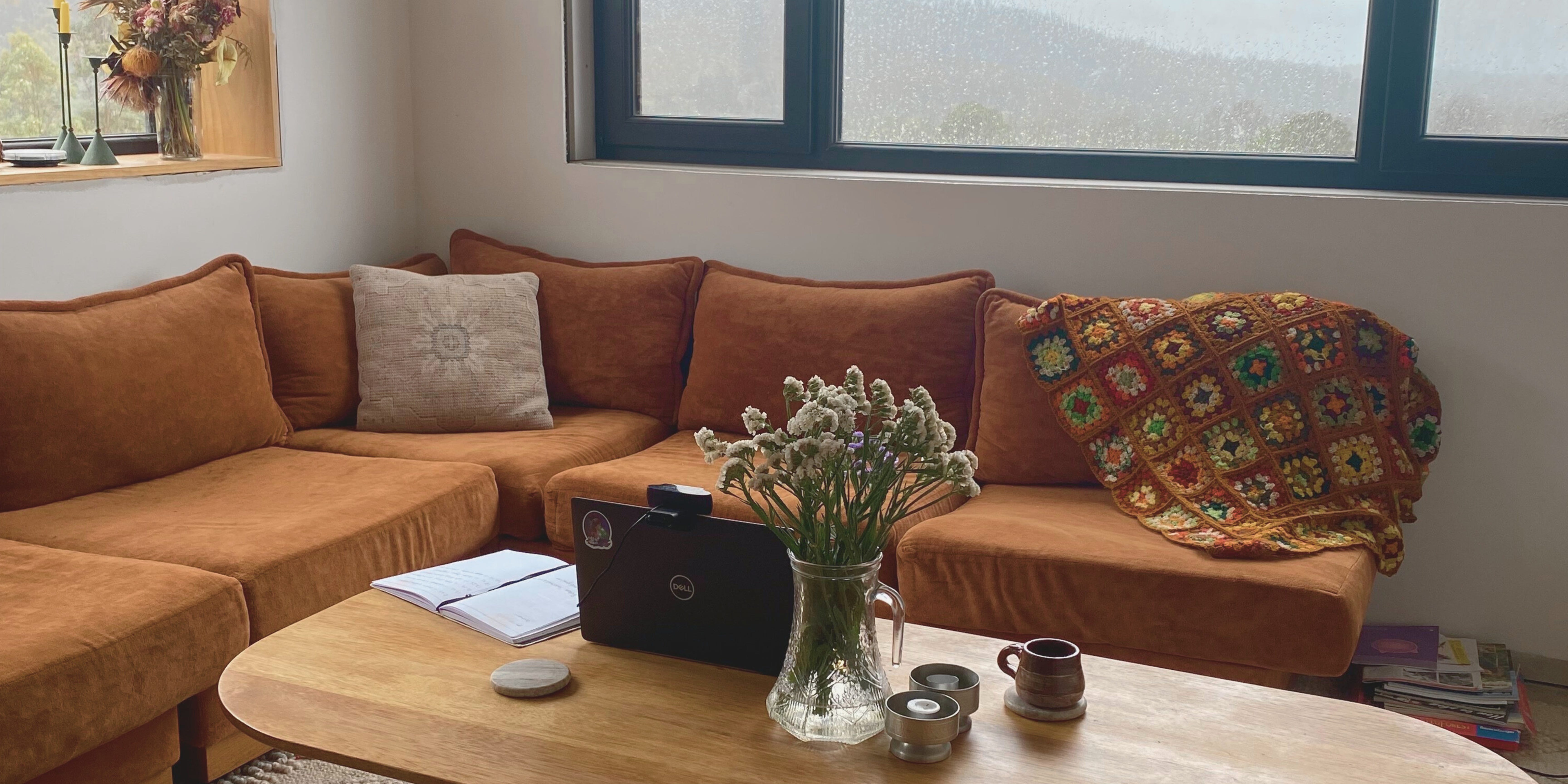
You naturally gravitate to low, open layouts wherever possible, including the ground level of a building or you may find that physically sitting on the floor helps you feel grounded and connected to wherever the people are. (I have a Valleys Environment and you will notice from the photo above that I prefer to be seated on the ground in the busiest room of the home. )
Areas surrounded by wide windows and unobstructed views are ideal for you.
You thrive in spaces with good acoustics, you could use sound-absorbing materials to reduce echo and enhance clarity.
Minimal clutter is important for Valleys people; arrange furniture for a cohesive expansive feel.
Shores Environment
People with a Shores Environment are drawn to places of convergence, where different elements or ideas collide and offer deep contemplation. They may also have an affinity for natural phenomena; sunsets, waterfalls, oceans, sunrises, star-gazing and landscapes where they can immerse themselves in a sense of wonder.
Place your workspace near windows, thresholds, or transitional areas where two environments meet, such as like balcony doors or between rooms.
Embrace changing scenery: rotate desk position seasonally, work in different rooms, or add elements that represent water and land.
Bring in scenes of wonder wherever you can, e.g. a telescope, artworks of natural phenomenon, galaxies, auroras- things that invite discussion about what’s possible.
Integrate décor that evolves throughout the day, such as adjustable lighting or art that shifts with mood.
Hopefully you’re feeling inspired to freshen up your workspace and experiment with some of these suggestions. I think we’re going to see a collective trend towards overly-technological workspaces in the next few years but that will also be balanced by the biophilic design elements that so many larger organisations are incorporating into their new builds. Just imagine if more people took a personalised approach to workplace design and acknowledged that what feels like a supportive and nourishing workspace for one person might not work for someone else- we would all benefit from the wider acceptance of tailored design and it can start with us reclaiming our own home offices and desks in the shared office.
Do you resonate with your Environment type? Where do you prefer to work and what elements make a space inviting? Let me know in the comments below.
What does Human Design reveal about the way you were designed to work?
Purchase your 20 page personalised Human Design Report to use as a resource for understanding the design of your aura and learning how you can navigate career decisions to create a work-life that is healthy and sustainable for your natural energy.
Want to go a little deeper? Get my eyes on your chart in a Career Alignment Session where we explore your career story within the context of your unique Human Design. Book a complimentary 20 minute career chat where we discuss your current situation and then if you decide to go ahead, we book in a time and I can tailor my support around your needs and your energetic design.